May 27, 2026
Stop Overtesting Your Products: The Real Difference Between IP67 and IP69K Protection Standards
Many Manufacturers Are Paying for the Wrong Waterproof TestsA surprising number of products fail not because of poor design, but because the wrong protection standard was selected during development.
Some products only require basic immersion protection but are unnecessarily tested to extreme conditions. Others pass IP67 certification yet fail after entering real industrial or automotive environments.
Consequences of Incorrect Testing:
Increased development costs
Delayed product launches
Customer complaints
Repeated certification expenses
Lower buyer confidence
As global industries demand higher reliability standards, choosing between IP67 and IP69K is no longer just a technical decision — it directly affects product positioning, market access, and long-term business growth.
For manufacturers developing automotive electronics, outdoor devices, charging systems, industrial controls, or smart equipment, understanding the difference between these two standards is critical before investing in waterproof test equipment.
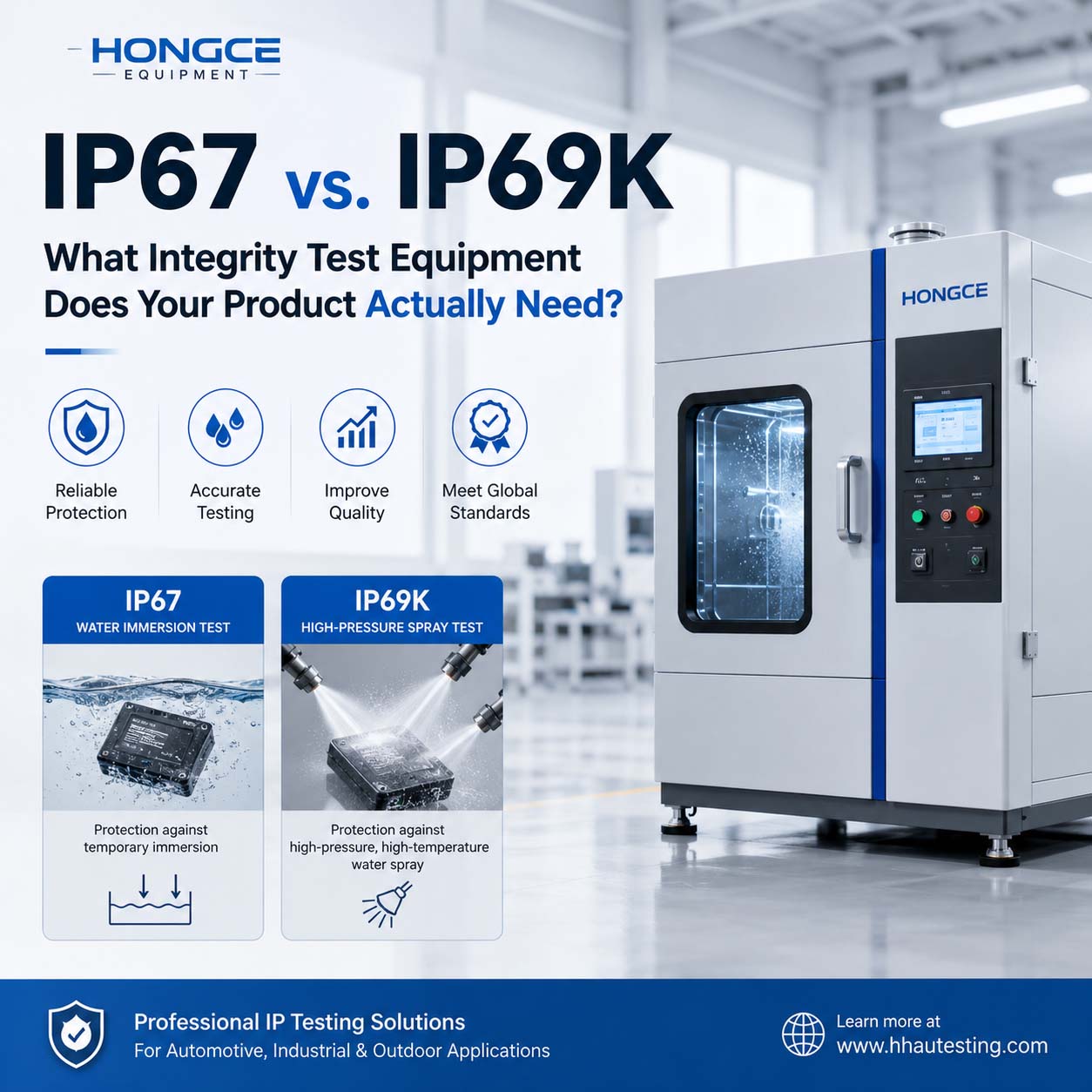
IP67 and IP69K Are Designed for Completely Different Environments
Many people believe IP69K is simply a stronger version of IP67.
That is not entirely accurate.
Although both belong to the IEC ingress protection classification system, the actual testing environments are fundamentally different.
IP67 focuses on temporary water immersion.
IP69K focuses on high-pressure, high-temperature cleaning conditions.
This distinction becomes extremely important when products are exposed to demanding real-world environments.
What IP67 Testing Actually Simulates
IP67 testing evaluates whether a product can survive accidental or temporary exposure to water.
During testing, products are typically:
Placed inside dust chambers
Tested for complete dust sealing
Submerged underwater under controlled conditions
Evaluated after immersion for internal leakage
This protection level is commonly used for:
Outdoor communication devices
LED lighting products
Consumer electronics
Portable industrial equipment
Smart sensors
Standard electrical enclosures
For many applications, IP67 protection is fully sufficient.
However, immersion resistance does not automatically guarantee resistance to high-pressure cleaning.
Why IP69K Became Essential in Modern Manufacturing
As electric vehicles, industrial automation, and outdoor infrastructure continue evolving, products now operate in harsher conditions than ever before.
Equipment may experience:
Repeated high-pressure cleaning
Hot water washdown cycles
Mud, dust, and road contamination
Long-term outdoor exposure
Severe temperature fluctuations
This is where IP69K testing becomes critical.
Unlike immersion testing, IP69K uses:
High-pressure water spray
Elevated water temperatures
Multiple spray angles
Rotational exposure conditions
The goal is to simulate aggressive cleaning and extreme operating environments.
Industries increasingly requiring IP69K include:
Electric vehicle systems
Automotive electronics
Charging connectors
Industrial automation equipment
Agricultural machinery
Outdoor energy systems
For these sectors, IP67 certification alone may not reflect actual operating reliability.
The Most Common Mistake Manufacturers Make
One of the biggest misconceptions in product testing is assuming:
“Higher IP rating always means better.”
In reality, unnecessary overtesting can increase:
Development costs
Product redesign complexity
Testing duration
Certification budgets
A product designed for standard outdoor use may never require high-pressure spray resistance.
At the same time, products installed in vehicles or industrial systems may fail prematurely if only IP67 validation is performed.
The correct approach is selecting the protection standard that matches the real application environment.
HONGCE EQUIPMENT: Supporting Reliable Waterproof Testing Worldwide
HONGCE EQUIPMENT provides professional environmental and waterproof testing solutions for global manufacturers and laboratories.
HONGCE testing systems support applications including:
IPX1 to IPX9K waterproof testing
High-pressure spray testing
Dustproof testing
Automotive electronics validation
Environmental simulation testing
Industrial reliability testing
With strong engineering experience and customized laboratory solutions, HONGCE helps manufacturers improve testing efficiency, strengthen product reliability, and meet international testing requirements.
FAQ
Is IP69K always necessary for outdoor products?
No. Many outdoor products only require IP67 protection. IP69K is typically needed for products exposed to high-pressure cleaning or demanding industrial conditions.
Can products pass IP67 but fail IP69K?
Yes. A product resistant to water immersion may still fail under high-pressure hot water spray conditions.
Which industries most commonly request IP69K testing?
Automotive electronics, EV charging systems, industrial automation, outdoor machinery, and heavy-duty equipment industries commonly require IP69K testing.
Why is waterproof testing important for product reliability?
Waterproof testing helps verify enclosure sealing performance, reduces environmental failure risks, and improves long-term operational durability.
Read More



 en
en ar
ar