enen/ arar
Home News

EV Battery Pack Air Tightness Testing: IP67/IP68 Equivalent Leak Rates & Test Solutions

EV Battery Pack Air Tightness Testing: IP67/IP68 Equivalent Leak Rates & Test Solutions

Oct 10, 2026

The sealing performance of new energy power battery packs is directly linked to their water resistance, dust resistance, and electrical safety; IP67 and IP68 are the most common industry standards for ingress protection. However, engineers often confuse the relationship between IP ratings and air leakage rates during equipment selection, leading to mismatches—either insufficient precision posing quality risks or excessive precision resulting in wasted investment.

Below, we break down the conversion logic between IP ratings and air leakage rates, as well as the selection of testing solutions for different production stages, to help manufacturers choose the right equipment.

First, let's clarify: What air leakage rates correspond to IP67 and IP68? It is important to understand the core concept: IP67 and IP68 are protection standards based on water immersion tests, whereas air-based airtightness testing on mass production lines is an equivalent substitute method; the relationship between the two is derived from fluid dynamics calculations.

Commonly accepted industry values ​​(positive-pressure air testing):

  • IP67: No water ingress at a depth of 1 meter for 30 minutes. Corresponds to an air leakage rate of approximately 1×10⁻⁵ Pa·m³/s.
  • IP68: Typically defined as no water ingress at a depth of 3 meters for 30 minutes (specifics depend on manufacturer specifications). Corresponds to an air leakage rate of approximately 1×10⁻⁶ Pa·m³/s.
  • Internal cooling circuits of liquid-cooled battery packs: Requirements are far stricter than those for housing protection, typically requiring ≤5×10⁻⁷ Pa·m³/s.

Important Note: The figures above refer to air leakage rates, not water or helium leakage rates. Values ​​vary significantly depending on the test medium and method; always verify the units and medium during selection to avoid confusion caused by supplier terminology.

Selecting Testing Solutions for Battery Pack Production Stages

As a battery pack progresses from a raw housing casting to a finished pack, the testing objectives and optimal methods vary by process step; it is not necessary to use the highest-precision equipment across the entire production line.

1. Housing Blank Stage: Rough Inspection via Pressure Decay Method

  • Purpose: Screen out major defects such as sand holes, cracks, and welding flaws to prevent waste in subsequent processes.
  • Method: Direct pressure method (pressure decay).
  • Leak rate requirement: Approximately 1×10⁻⁴ Pa·m³/s.
  • Advantages: Fast (under 10 seconds), low equipment cost; suitable for high-volume preliminary screening.

2. Post-Machining / Pre-Pack Assembly: Intermediate Inspection via Differential Pressure Method

  • Purpose: Verify the sealing performance of machined surfaces and sealing interfaces; this is the most critical quality checkpoint.
  • Method: Differential pressure leak detection (must include temperature compensation).
  • Leak rate requirement: 1×10⁻⁵ to 5×10⁻⁶ Pa·m³/s.
  • Advantages: Balances accuracy and speed (15–25 seconds per station); suitable for mass production cycle times.
  • Note: Differential pressure methods are fully adequate for standard, small-volume housings; for large enclosures with internal volumes >10L, the mass flow method is recommended.

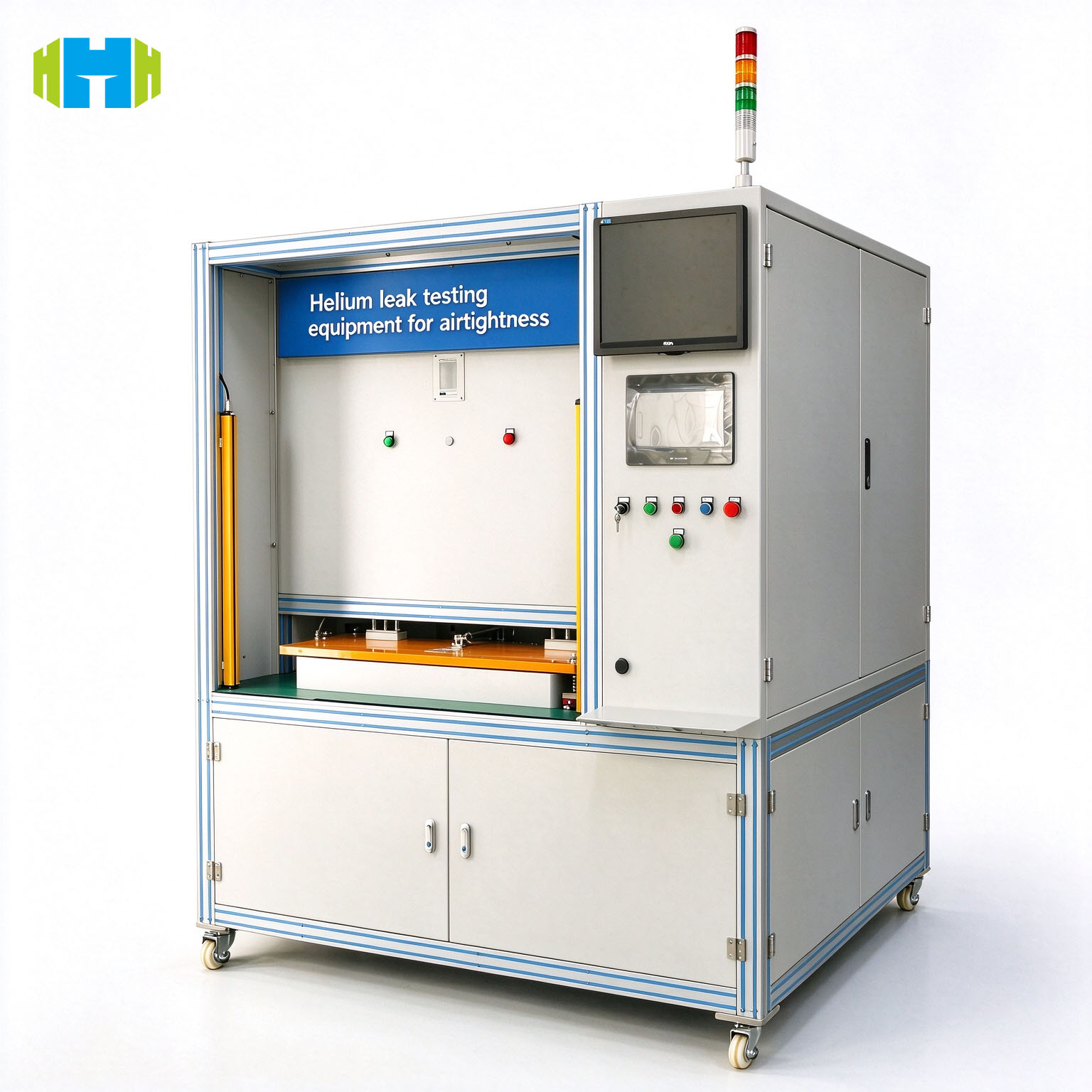
3. Finished Pack Inspection: Precision Inspection via Helium Mass Spectrometry

  • Purpose: Final seal verification before shipment, covering all sealing points (connectors, wiring harnesses, explosion-proof valves, etc.).
  • Method: Vacuum chamber helium mass spectrometry.
  • Leak rate requirement: 1×10⁻⁶ Pa·m³/s or lower.
  • Advantages: Highest accuracy, data traceability; meets export and relevant quality system requirements.

Tips: 3 Golden Rules for Equipment Selection

  1. Don't focus solely on "instrument resolution"; always ask for the detectable leak rate of the *system* (including tooling), as the two figures often differ by 1–2 orders of magnitude.
  2. Temperature compensation is essential for mass production lines; in workshop environments with significant temperature fluctuations, differential pressure instruments without compensation can have false-rejection rates exceeding 10%.
  3. Plan for future upgrades: Battery industry standards are constantly tightening; prioritize equipment with expandable ranges and modular upgrade capabilities to avoid the entire unit becoming obsolete within two years.

leave a message

leave a message
If you are interested in our equipment and want to know more details, please leave a message here. we will contact you as soon as possible.
Submit

Our hours

Mon 11/21 - Wed 11/23: 9 AM - 8 PM
Thu 11/24: closed - Happy Thanksgiving!
Fri 11/25: 8 AM - 10 PM
Sat 11/26 - Sun 11/27: 10 AM - 9 PM
(all hours are Eastern Time)

Contact Us:iven@hjauto.com.cn

Home

Products

whatsApp

contact