
Emial Us :
iven@hjauto.com.cn
leave a message
If you are interested in our equipment and want to know more details, please leave a message here.
we will contact you as soon as possible.
After visiting dozens of refrigeration manufacturing plants, the biggest waste we see over and over is poor leak test equipment selection.
Small factories making residential valves splurge on high-precision helium systems, tripling their cost and cutting throughput in half — for no actual quality gain. Plants making export heat exchangers cut corners with differential pressure, only to have entire shipments rejected at destination for leak failures — one rejection costs as much as three machines. Even more common: expensive equipment arrives, but tooling doesn’t fit right, helium runs through budget, false rejection rates swing wildly, and support goes dark. The more you try to fix it, the more problems you get.
When done right, leak testing balances precision, cost and cycle time. When done wrong, you either risk quality failures or burn budget. Drawing on real-world experience from hundreds of production lines across the refrigeration industry, this article breaks down selection logic for every application — from valves to complete systems, from production floor to field service.
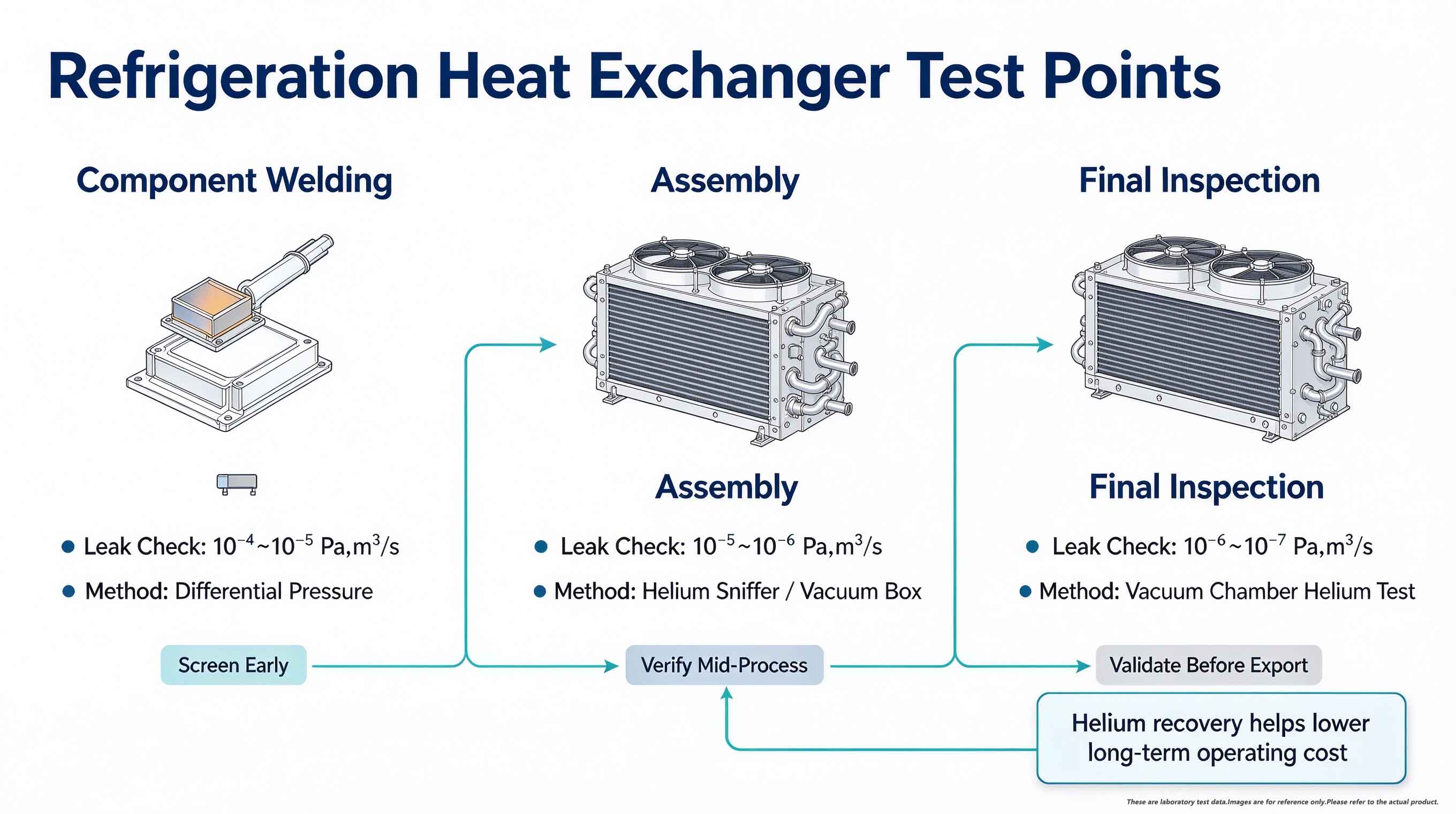
There’s a common myth in selection: higher precision is always better. For solenoid valves, expansion valves and short tube assemblies, differential pressure is fully sufficient. Premium helium testing here is pure waste.
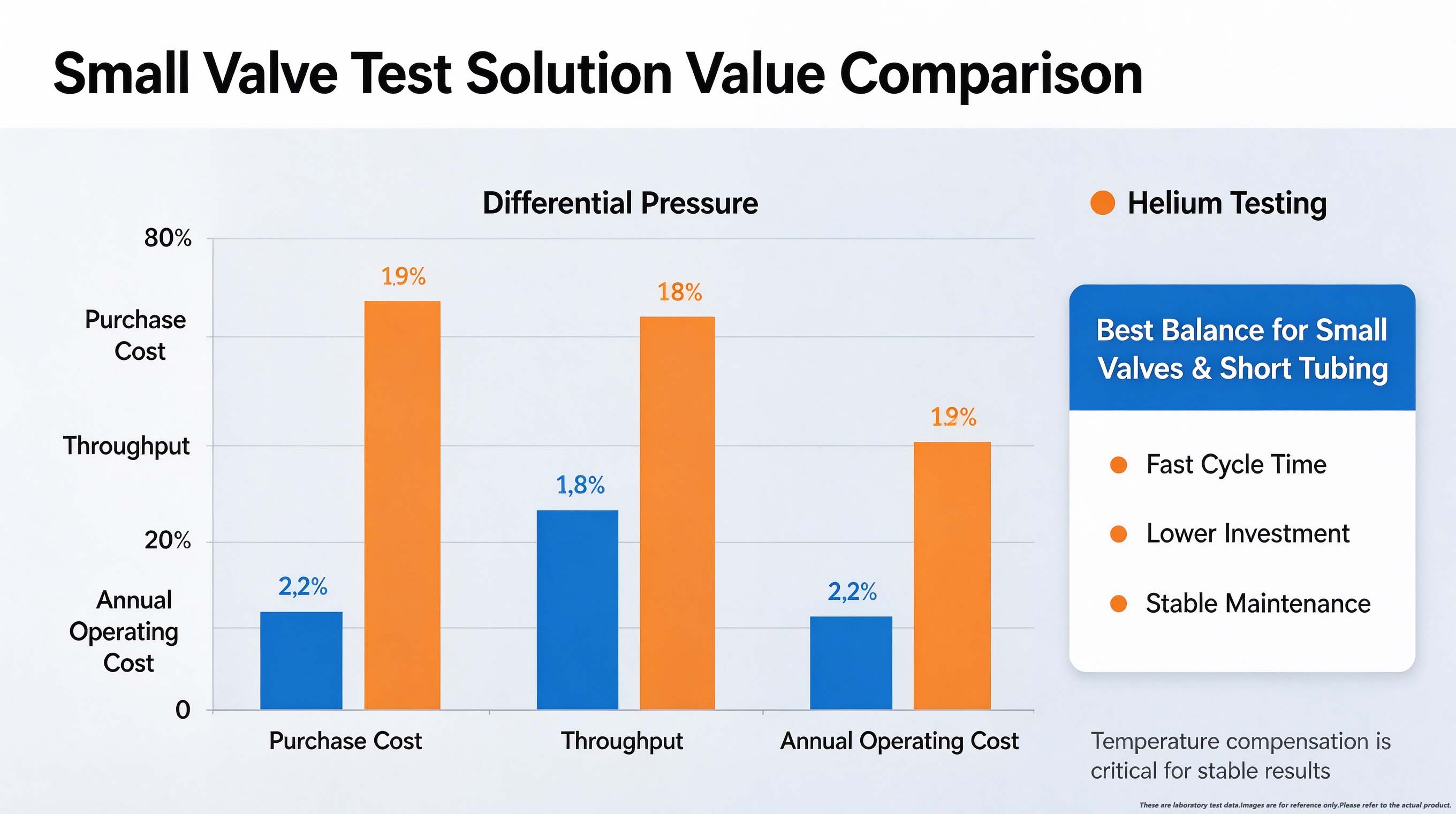
If differential pressure works for rough screening on valves, heat exchangers — with long weld seams, distributed leak points and direct refrigerant containment — absolutely require helium for final inspection.
Especially for export orders, commercial refrigeration and EV air conditioning — EU F-Gas regulations and domestic emission controls mandate quantified refrigerant leakage. Differential pressure can’t deliver accurate quantification or traceable data, and simply won’t pass audit.
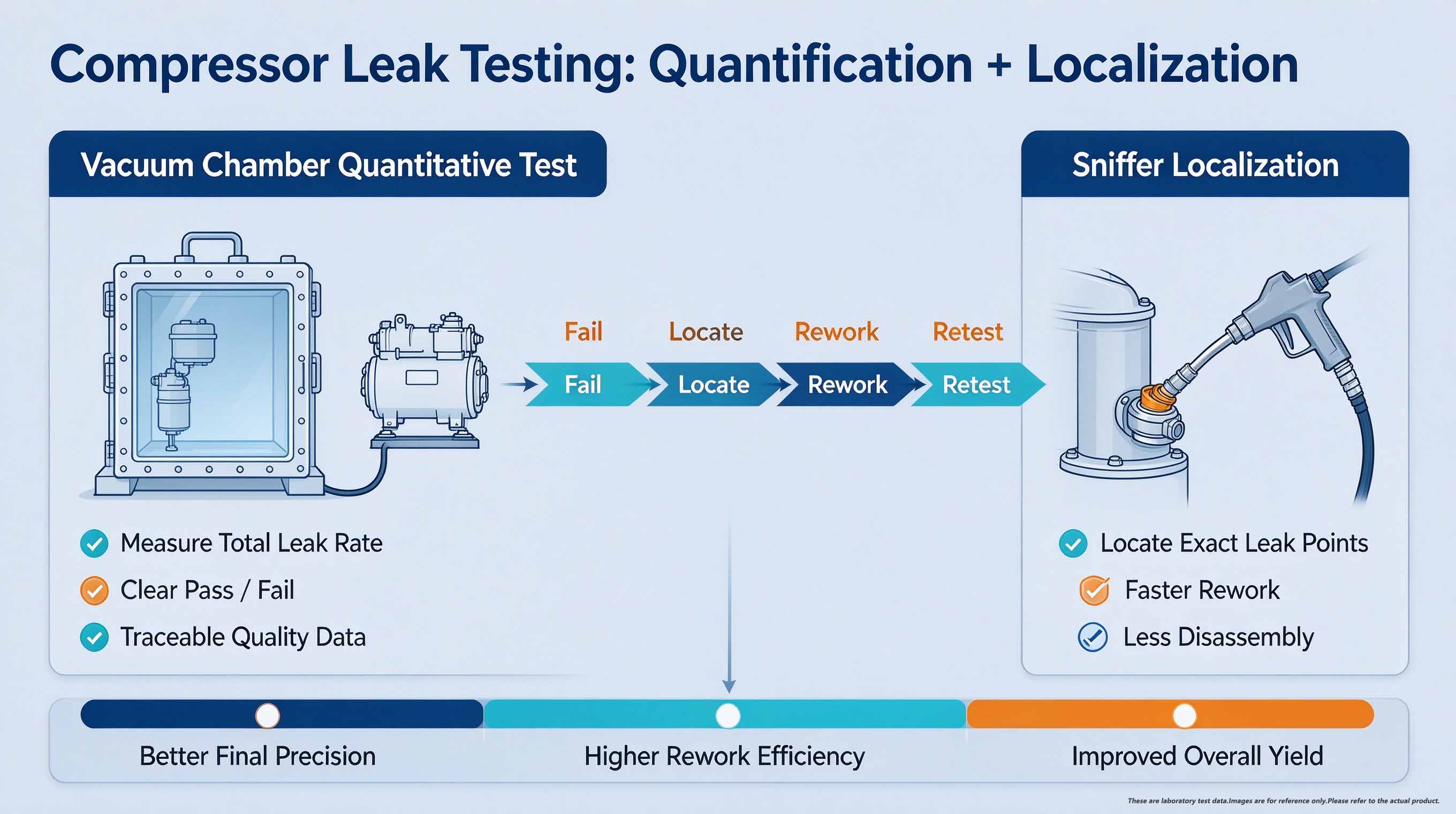
Compressors are the heart of any refrigeration system. They have the tightest leak requirements, and when they fail, you need to find the leak fast — not have technicians guessing.
The optimal setup is a “vacuum chamber quantification + sniffer localization” combination:
Leak testing doesn’t only happen on the production line. Field installation, routine service calls and troubleshooting all need leak detection capability.
For these scenarios, don’t try to move production equipment. One portable sniffer helium leak detector does the job:
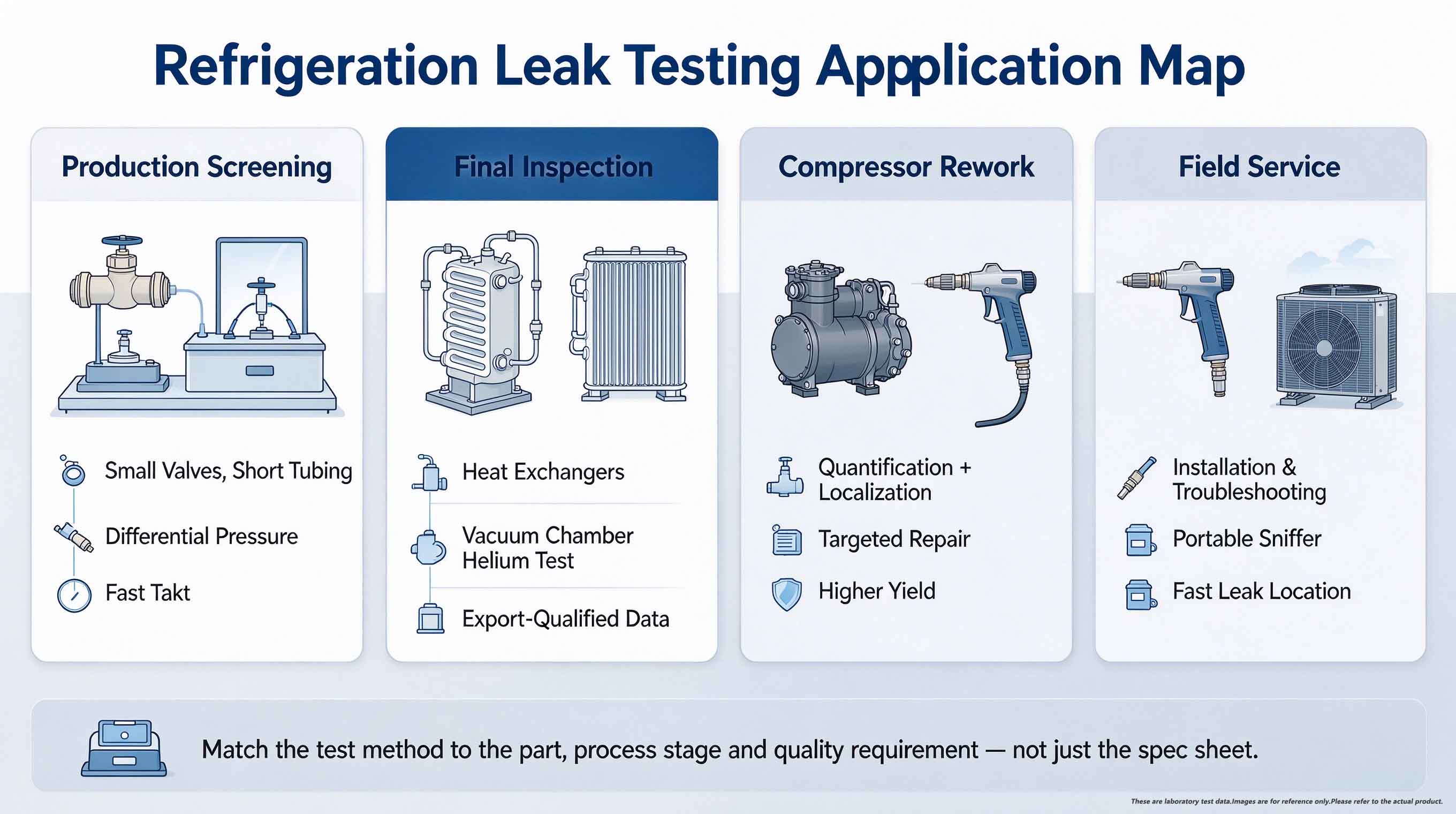
Leak testing in refrigeration was never just “buying a machine.” Different parts, different process stages, different market requirements all call for different optimal solutions. Don’t just fixate on equipment specs when selecting. Start with your process, production volume and quality requirements, then match the right solution — fewer detours, fewer pitfalls.
Our hours
Mon 11/21 - Wed 11/23: 9 AM - 8 PM
Thu 11/24: closed - Happy Thanksgiving!
Fri 11/25: 8 AM - 10 PM
Sat 11/26 - Sun 11/27: 10 AM - 9 PM
(all hours are Eastern Time)

 en
 ar